

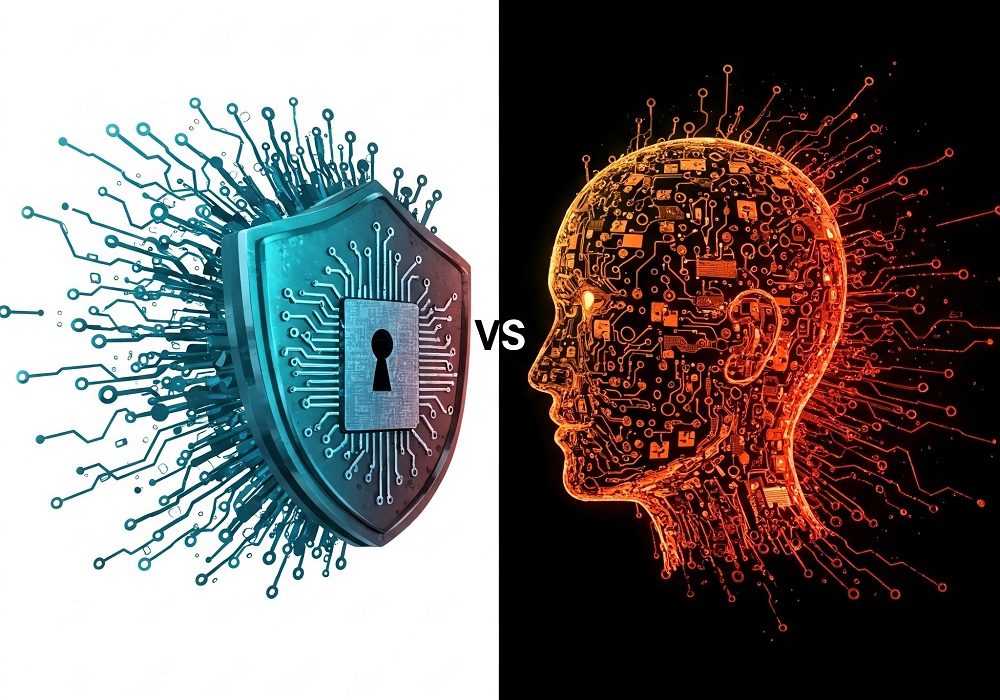
Introduction: cybersecurity or artificial intelligence
In today’s rapidly growing tech industry, two career paths have become especially popular: Cybersecurity and Artificial Intelligence (AI). Both fields offer exciting opportunities, high salaries, and strong job security—but for beginners, one common question often comes up:
“Which is easier to learn—cybersecurity or artificial intelligence?”
The answer isn’t always simple. While both fields involve technology and problem-solving, they require different skills, learning approaches, and mindsets. Some learners might find cybersecurity’s practical nature more straightforward, while others might enjoy the theoretical challenges of AI.
In this article, we’ll break down the core differences between these two career paths—from learning difficulty and required skills to job prospects and long-term growth. Whether you’re a student, a career switcher, or simply exploring the tech world, this guide will help you decide which field is the right fit for you.
Understanding the Basics
Before diving into which career is easier to learn, it’s essential to understand what each field involves. While Cybersecurity and Artificial Intelligence are both rooted in technology, they differ significantly in their focus and applications. Let’s break them down.
What is Cybersecurity?
Cybersecurity is the practice of protecting systems, networks, and data from digital threats, including hacking, data breaches, and malware attacks. It focuses on safeguarding sensitive information, ensuring privacy, and preventing unauthorized access to critical systems.
Key areas of cybersecurity include:
-
Network Security: Protecting computer networks from intrusions and vulnerabilities.
-
Ethical Hacking: Legally testing systems and networks to identify weaknesses.
-
Risk Management: Assessing and managing security risks in an organization.
-
Incident Response: Responding to and mitigating the effects of cyberattacks.
Cybersecurity professionals are the defenders of the digital world. They monitor networks, detect potential threats, and implement security measures to ensure that everything remains safe and secure.
What is Artificial Intelligence?
Artificial Intelligence (AI) is the simulation of human intelligence in machines designed to think, learn, and problem-solve like humans. AI uses algorithms and data to enable computers to perform tasks that typically require human intelligence, such as recognizing patterns, making decisions, and understanding language.
Key areas of AI include:
-
Machine Learning: A subset of AI where machines learn from data to improve their performance over time.
-
Natural Language Processing (NLP): Enabling machines to understand and interact with human language.
-
Computer Vision: Allowing machines to interpret and make decisions based on visual inputs.
-
Robotics: Creating machines that can perform physical tasks autonomously.
AI professionals are innovators, building intelligent systems that can adapt, learn, and improve on their own. This field blends computer science, data analysis, and even neuroscience to create machines that simulate cognitive functions.
Learning Curve
When deciding between Cybersecurity and Artificial Intelligence, one of the most crucial factors to consider is the learning curve. Both fields require specific technical knowledge, but the type of knowledge and the difficulty of learning vary significantly. Let’s dive into the skills you’ll need to get started in both areas.
Required Skills for Cybersecurity
Cybersecurity is often seen as more practical compared to AI, which can make it easier to start learning, especially for beginners. While foundational knowledge of networking, systems administration, and programming is essential, you don’t necessarily need to dive into complex mathematical concepts right away.
Some key skills you’ll need include:
-
Networking Concepts: Understanding how networks work is fundamental in cybersecurity. Knowing how data flows across the internet and how to protect these flows is a core skill.
-
Programming: Although not as intensive as AI, cybersecurity professionals still need to know some basic coding languages like Python, C or Java for tasks like automating security processes or writing scripts for penetration testing.
-
Operating Systems: Familiarity with operating systems, particularly Linux and Windows, is vital since most cyberattacks target systems or networks.
-
Cryptography: Understanding encryption techniques and how data can be securely stored and transmitted is crucial in many cybersecurity jobs.
Required Skills for Artificial Intelligence
Artificial Intelligence, on the other hand, requires more theoretical knowledge, particularly in mathematics and statistics, as well as more complex programming skills. AI professionals often work with large datasets, creating models that require both a deep understanding of algorithms and a good grasp of how data can be manipulated and used to “train” machines.
Some key skills you’ll need for AI include:
-
Programming Languages: Python is the most widely used language in AI, along with other languages such as R and Java. AI relies heavily on libraries and frameworks like TensorFlow, PyTorch, and Keras to build and train models.
-
Mathematics & Statistics: AI requires a solid foundation in linear algebra, probability, calculus, and statistics—especially for machine learning and deep learning algorithms.
-
Data Science: You’ll need to be comfortable working with large datasets, performing data cleaning, and using algorithms to extract meaningful insights from raw data.
-
Machine Learning Algorithms: Understanding various machine learning techniques, such as supervised learning, unsupervised learning, and reinforcement learning, is essential for building intelligent systems.
Time to Learn
The time it takes to learn either field depends largely on your prior knowledge and the resources you have at hand. However, based on the nature of the fields, cybersecurity tends to have a shorter learning curve for beginners.
-
Cybersecurity: If you are a beginner, you can typically pick up the fundamentals in 3–6 months with focused learning. Entry-level certifications, like CompTIA Security+ or Certified Ethical Hacker (CEH), can be obtained relatively quickly.
-
Artificial Intelligence: AI, due to its more advanced mathematical and programming requirements, might take a bit longer to master. Most individuals can expect to spend 6 months to 1 year learning the basics, with a deeper understanding and specialization taking much longer.
Job Opportunities & Salaries
One of the main factors to consider when choosing between Cybersecurity and Artificial Intelligence is the job market and salary potential. Both fields are in high demand, but there are some key differences in terms of roles, job growth, and compensation. Let’s take a closer look at what you can expect in each career.
Cybersecurity Job Opportunities
The demand for cybersecurity professionals continues to grow as cyber threats become more sophisticated. With businesses and government organizations increasingly relying on technology, the need to protect sensitive data and systems is critical. As a result, cybersecurity offers a wide range of career opportunities.
Some common job roles in cybersecurity include:
-
Cybersecurity Analyst: Entry-level role focused on monitoring and responding to security incidents.
-
Penetration Tester (Ethical Hacker): Responsible for testing systems and networks for vulnerabilities.
-
Security Architect: Designs and implements security measures for networks and infrastructure.
-
Chief Information Security Officer (CISO): Senior leadership role overseeing the entire security strategy of an organization.
The cybersecurity field is expected to continue growing, with the U.S. Bureau of Labor Statistics (BLS) predicting a 31% job growth in information security analyst positions from 2019 to 2029—much faster than the average for all occupations.
Average Salary in Cybersecurity
-
Entry-Level: Around $60,000–$80,000 per year.
-
Mid-Level: Around $90,000–$120,000 per year.
-
Senior-Level: Roles like CISO can earn over $150,000–$200,000 per year.
Artificial Intelligence Job Opportunities
Artificial Intelligence is a rapidly evolving field, with applications in various industries, from healthcare and finance to autonomous vehicles and robotics. As AI technologies advance, the demand for AI professionals continues to rise. AI experts are in high demand, particularly in fields like machine learning, data science, and natural language processing.
Common job roles in AI include:
-
Machine Learning Engineer: Designs algorithms that allow systems to learn from data and improve over time.
-
Data Scientist: Works with large datasets to create models and algorithms that drive decision-making.
-
AI Researcher: Focuses on advancing the theoretical aspects of AI and machine learning.
-
Robotics Engineer: Develops machines and robots that can perform tasks autonomously using AI.
As AI becomes more integrated into everyday life, industries are looking to hire specialists who can create innovative AI solutions. The AI job market is predicted to grow by 42% from 2019 to 2029, which is much faster than average.
Average Salary in AI
-
Entry-Level: Around $80,000–$100,000 per year.
-
Mid-Level: Around $120,000–$150,000 per year.
-
Senior-Level: Experienced AI researchers or engineers can earn $160,000–$250,000 or more per year, depending on expertise.
Which Field Offers More Job Security?
Both cybersecurity and AI offer robust job security, but with different focuses:
-
Cybersecurity: The increasing frequency of cyberattacks makes cybersecurity a vital and ongoing need. This demand ensures long-term job security, as businesses will always need to protect their digital assets.
-
Artificial Intelligence: AI is a rapidly growing field, especially in automation and machine learning, offering excellent job security as the demand for smarter, more autonomous systems continues to expand.
Complexity & Accessibility
When it comes to choosing between Cybersecurity and Artificial Intelligence, understanding the complexity of each field and how accessible they are to beginners is essential. Both areas have their challenges, but depending on your strengths and preferences, one might feel more accessible than the other.
Which is Easier for Beginners: Cybersecurity or AI?
For many beginners, Cybersecurity tends to be more accessible and practical compared to AI. This is because cybersecurity often requires hands-on learning and problem-solving in real-world scenarios, making it easier to understand and implement.
-
Cybersecurity: The field is more tangible, with clear and immediate applications. For instance, learning how to configure a firewall or conduct a vulnerability assessment is something that you can directly see and apply. Many beginners can start learning cybersecurity concepts through online courses, tutorials, and hands-on practice using virtual machines and open-source tools.
-
AI: AI, on the other hand, is much more abstract and requires a deeper understanding of mathematics and statistics. The theoretical nature of AI can make it challenging for those without a strong math background, as much of the work involves complex algorithms and computations. AI also involves data manipulation and creating models, which can be difficult for those who are new to programming or don’t have a solid grasp of mathematical concepts.
Practical vs. Theoretical
-
Cybersecurity is often considered more practical because it involves protecting real-world systems and networks. Many cybersecurity professionals find satisfaction in solving immediate, concrete problems, like identifying a security breach or defending against a cyberattack. The field also provides numerous opportunities for hands-on learning, including setting up firewalls, securing servers, and testing systems for vulnerabilities.
-
Artificial Intelligence is more theoretical, requiring a solid understanding of algorithms and how they function. AI practitioners spend a lot of time designing and testing models, which can be an abstract process. Unlike cybersecurity, where results are often immediate and visible, AI’s results take time to develop and may require extensive training of models to achieve meaningful outcomes.
Real-Life Examples to Illustrate Difficulty
Let’s look at a couple of real-life examples to better understand the complexity of each field:
-
In Cybersecurity, a simple real-life example would be setting up a VPN or running an intrusion detection system. While this can be challenging at first, the steps are clear, and results are measurable (e.g., whether the system successfully blocks attacks).
-
In AI, consider the task of training a machine learning model to recognize images. This requires large datasets, programming skills, and in-depth knowledge of machine learning algorithms. The complexity increases when adjusting parameters, choosing the right model, or troubleshooting issues with accuracy.
Accessibility of Learning Resources
Another important factor to consider is the availability of learning resources. Fortunately, both fields are well-supported with abundant learning materials, but the type of content and delivery methods can differ:
-
Cybersecurity: Resources like online courses (e.g., CompTIA Security+, Cybrary), books, and bootcamps focus heavily on hands-on, practical experiences. Cybersecurity tools, such as Kali Linux, Wireshark, and Metasploit, offer real-world training, allowing beginners to practice what they’ve learned in a safe environment.
-
Artificial Intelligence: While AI also has a wealth of online courses (e.g., Coursera, edX, Kaggle), books, and tutorials, the learning curve is steeper due to the complexity of the subject matter. AI resources often focus on math-heavy concepts like linear algebra and calculus, making them less approachable for those without a solid foundation in these areas.
Ultimately, Cybersecurity is generally considered the easier field for beginners to dive into. It is more accessible for individuals without advanced technical knowledge and provides immediate, hands-on learning opportunities. If you’re looking to start a career in tech relatively quickly, cybersecurity might be a more suitable option.
However, if you have a strong background in math and enjoy theoretical work, Artificial Intelligence may be more engaging and rewarding, though it will likely take longer to master due to its inherent complexity.
Certifications & Learning Resources
Whether you decide to pursue a career in Cybersecurity or Artificial Intelligence, obtaining relevant certifications and utilizing the best learning resources can help you stand out in the job market. Both fields offer a variety of certifications and learning materials that cater to different experience levels, from beginners to experts.
Cybersecurity Certifications
Cybersecurity certifications are a great way to showcase your skills and knowledge to employers. These certifications validate your ability to protect systems, networks, and data from security threats and breaches. Here are some of the top cybersecurity certifications:
1. CompTIA Security+
-
Level: Beginner to Intermediate
-
Description: CompTIA Security+ is one of the most well-known entry-level cybersecurity certifications. It covers essential security concepts, including threat management, cryptography, and network security.
-
Why Choose It: This certification is widely recognized in the industry and is a great starting point for those looking to break into cybersecurity.
2. Certified Ethical Hacker (CEH)
-
Level: Intermediate to Advanced
-
Description: The CEH certification is aimed at individuals interested in becoming ethical hackers or penetration testers. It focuses on testing and exploiting vulnerabilities in networks and systems to help organizations strengthen their security.
-
Why Choose It: If you want to pursue a career in penetration testing or vulnerability assessment, CEH is a highly respected credential.
3. Certified Information Systems Security Professional (CISSP)
-
Level: Advanced
-
Description: CISSP is a globally recognized certification for senior cybersecurity professionals. It focuses on the management of cybersecurity programs, risk management, and compliance.
-
Why Choose It: This is a great choice for those aiming for leadership positions such as Chief Information Security Officer (CISO) or security architects.
4. Cisco Certified CyberOps Associate
-
Level: Intermediate
-
Description: This certification focuses on security operations and incident response. It covers topics such as network monitoring, security monitoring tools, and responding to incidents in real time.
-
Why Choose It: If you’re interested in working in a Security Operations Center (SOC), this certification will equip you with the right skills.
AI Certifications
Artificial Intelligence is a rapidly growing field, and obtaining certifications in AI can help demonstrate your expertise to employers. Here are some of the top AI certifications that can give your career a boost:
1. AI and Machine Learning Specialization by Coursera
-
Level: Beginner to Intermediate
-
Description: Offered by top universities such as Stanford and the University of Washington, this specialization includes courses that cover machine learning, neural networks, and deep learning. It provides a comprehensive introduction to AI.
-
Why Choose It: This course is perfect for beginners who want to learn the basics of AI and machine learning from industry leaders.
2. Microsoft Certified: Azure AI Fundamentals
-
Level: Beginner to Intermediate
-
Description: This certification covers the fundamentals of AI, including machine learning, computer vision, natural language processing (NLP), and conversational AI. It’s based on Microsoft Azure and its AI capabilities.
-
Why Choose It: If you’re interested in AI in the cloud, especially using Microsoft Azure, this is a great certification to start with.
3. TensorFlow Developer Certificate
-
Level: Intermediate to Advanced
-
Description: This certification validates your knowledge in building AI models using TensorFlow, one of the most widely used libraries in machine learning. It covers topics such as neural networks and deep learning techniques.
-
Why Choose It: TensorFlow is a key tool for AI practitioners. This certification is ideal for those looking to specialize in deep learning and neural networks.
4. Google Cloud Professional Machine Learning Engineer
-
Level: Advanced
-
Description: This certification is designed for professionals who are already experienced in machine learning and want to deepen their expertise in deploying machine learning models on Google Cloud.
-
Why Choose It: If you plan to work with machine learning in cloud environments, this certification will give you the expertise to work with Google Cloud’s machine learning tools.
Top Learning Resources for Cybersecurity
There are many online platforms and bootcamps offering valuable learning resources for aspiring cybersecurity professionals. Some of the top platforms for hands-on learning and theory include:
1. Cybrary
-
Overview: Cybrary offers courses on a wide range of cybersecurity topics, including network security, ethical hacking, and compliance. It also provides certification prep courses for certifications like CompTIA Security+ and CISSP.
-
Why Choose It: Cybrary’s hands-on labs and real-world scenarios make it ideal for learning practical cybersecurity skills.
2. Udemy
-
Overview: Udemy offers many affordable courses on cybersecurity fundamentals, ethical hacking, and penetration testing. Courses are created by industry experts and cater to different experience levels.
-
Why Choose It: Great for those who want to learn at their own pace and access a variety of affordable cybersecurity courses.
3. Pluralsight
-
Overview: Pluralsight is a popular learning platform for IT and cybersecurity professionals. It offers courses in ethical hacking, cloud security, and incident response.
-
Why Choose It: Pluralsight’s expert-led courses are structured, making it easy to build knowledge in cybersecurity systematically.
Top Learning Resources for AI
AI requires a mix of theory and practical experience. The following platforms offer courses and resources to help you gain expertise in AI:
1. Coursera
-
Overview: Coursera offers various AI and machine learning specializations, including courses from top universities like Stanford University and University of Toronto. Courses like Machine Learning by Andrew Ng are incredibly popular among beginners.
-
Why Choose It: Coursera offers a structured, academic approach to AI, providing in-depth knowledge from world-renowned instructors.
2. edX
-
Overview: edX offers courses in AI, machine learning, and deep learning, created by universities like Harvard and MIT. The platform offers a range of free and paid courses, many of which are self-paced.
-
Why Choose It: edX’s certifications and degrees are recognized globally and ideal for those who want to study AI in a university-style setting.
3. Kaggle
-
Overview: Kaggle is a platform dedicated to data science and machine learning, offering a rich set of datasets and competitions to practice AI. It also offers tutorials on how to use AI tools like Python and TensorFlow.
-
Why Choose It: Kaggle is excellent for hands-on learning and practice, especially if you’re keen on working with real-world data and solving AI-related problems.
No matter which field you choose—Cybersecurity or AI—investing in the right certifications and learning resources is a crucial step to building a successful career. Cybersecurity certifications tend to be more practical, while AI certifications focus more on theoretical and technical skills.
Long-Term Career Growth
When choosing a career path, it’s essential to consider not only the entry-level opportunities but also the long-term growth potential. Both Cybersecurity and Artificial Intelligence (AI) offer strong career advancement opportunities, but they differ in terms of job roles, industry demand, salary progression, and leadership potential.
Cybersecurity: A Steady and Growing Career Path
📈 Industry Demand
Cybersecurity is a field that continues to grow steadily due to the rising number of cyberattacks and digital threats. From small startups to large enterprises, everyone needs cybersecurity experts to protect their data and systems. According to (ISC)², there’s a global shortage of over 3.4 million cybersecurity professionals — a gap that is widening each year.
💼 Career Progression
Cybersecurity professionals typically start in roles like Security Analyst or Network Security Administrator. With experience and certifications, they can progress to:
-
Penetration Tester
-
Cybersecurity Consultant
-
Security Architect
-
Chief Information Security Officer (CISO)
These roles often involve managing teams, handling organizational security strategies, and responding to large-scale security incidents.
💸 Salary Growth
Cybersecurity careers offer strong earning potential. According to PayScale and Glassdoor:
-
Entry-level: $60,000 – $80,000/year
-
Mid-level (Penetration Tester, Security Engineer): $90,000 – $120,000/year
-
Senior/Leadership (CISO): $150,000 – $250,000+/year
🛡️ Job Security
One of the biggest benefits of a cybersecurity career is job stability. With cyber threats constantly evolving, organizations are always in need of skilled professionals. This creates a relatively secure and recession-resistant career.
Artificial Intelligence: The Future-Forward Career
🚀 Explosive Growth Potential
AI is transforming industries — from healthcare and finance to transportation and entertainment. As more companies adopt automation, predictive analytics, and machine learning, the demand for AI talent is skyrocketing. According to LinkedIn, AI Specialist has been one of the top emerging jobs in recent years.
💼 Career Progression
AI professionals often begin as Machine Learning Engineers, Data Scientists, or AI Researchers. With experience, they can grow into roles like:
-
AI Architect
-
NLP Engineer
-
Computer Vision Specialist
-
Head of AI or Chief Data Scientist
These roles typically involve leading AI development projects, managing teams, and working with cross-functional departments to integrate AI systems.
💸 Salary Growth
AI roles are among the highest-paying in tech due to the specialized knowledge required. Here’s a rough salary breakdown:
-
Entry-level: $80,000 – $100,000/year
-
Mid-level (AI/ML Engineer, Data Scientist): $110,000 – $150,000/year
-
Senior/Leadership (AI Director, Chief AI Officer): $180,000 – $300,000+/year
📊 Future-Proof Skills
AI is at the forefront of innovation, making it one of the most future-proof skillsets. However, since AI evolves quickly, professionals must be committed to continuous learning and staying updated with the latest trends, tools, and frameworks.
Cybersecurity vs. AI: Growth Comparison Table
| Factor | Cybersecurity | Artificial Intelligence |
|---|---|---|
| Job Demand | Very High (Stable Growth) | Extremely High (Explosive Growth) |
| Salary Potential | High | Very High |
| Career Advancement | Strong, with leadership roles | Strong, with niche specialization |
| Learning Curve | Moderate to steep | Steep |
| Recession Resistance | Strong | Moderate to strong |
| Innovation Involvement | Moderate (defensive & analytical) | Very High (creative & technical) |
Conclusion: Which Career Offers Better Long-Term Growth?
-
Choose Cybersecurity if you’re looking for a stable, in-demand, and recession-resistant career with clear pathways to leadership.
-
Choose AI if you’re excited by innovation and want to be at the cutting edge of technology, with opportunities to shape the future of industries.
Ultimately, both fields offer excellent long-term growth — your decision should align with your interests, strengths, and career vision.
Final Verdict – Which One Should You Choose?
Now that we’ve broken down the key differences between Cybersecurity and Artificial Intelligence across learning curves, job opportunities, technical skills, salary potential, and long-term growth — it’s time to answer the big question:
Which one is easier, and which one is right for YOU?
✅ Choose Cybersecurity if:
-
You enjoy solving problems, analyzing risks, and protecting systems.
-
You prefer a more defined path with faster entry into the job market.
-
You’re looking for a stable, in-demand job that doesn’t require advanced math.
-
You want to work across a wide range of industries with high job security.
-
You enjoy structured roles and continuous, but manageable learning.
Cybersecurity is easier to enter for many beginners because the technical bar to get started is lower, and hands-on training like certifications (e.g., CompTIA Security+, CEH) can quickly open job opportunities.
✅ Choose Artificial Intelligence if:
-
You’re passionate about building smart systems and working with cutting-edge technology.
-
You have a strong background (or interest) in math, statistics, and coding.
-
You want to work on the future of automation, robotics, and machine learning.
-
You’re okay with a steep learning curve and longer time to job-readiness.
-
You’re excited about research, experimentation, and pushing boundaries.
AI is more complex but offers higher rewards for those willing to invest time and effort. It’s ideal for those who love to innovate and tackle big data challenges.
💡 Final Thoughts: cybersecurity or artificial intelligence
Cybersecurity and Artificial Intelligence are not just tech buzzwords — they’re career-defining domains that offer vast opportunities, excellent salaries, and long-term stability. The real decision comes down to your personal interests, career goals, and willingness to learn.
If you’re still unsure, consider this:
🧠 Cybersecurity protects today. AI builds tomorrow.
So, ask yourself:
Do you want to defend and secure, or build and innovate?
Whichever you choose, you’re stepping into a future-proof, high-impact career.



Top Emerging Technologies in 2025 and Their Impact on Everyday Life - Techkruch
May 10, 2025[…] Which is easy Cybersecurity or Artificial Intelligence? […]